
Part 2 – 12 Graphs That Show Why People Get Fat
Dr. Eric Montagne June 18, 2020 Advice, Conseils, Uncategorized 0People are fatter and sicker than ever before (continuation from previous article)
7. Increased Food Variety Contributes to Overeating and Weight Gain
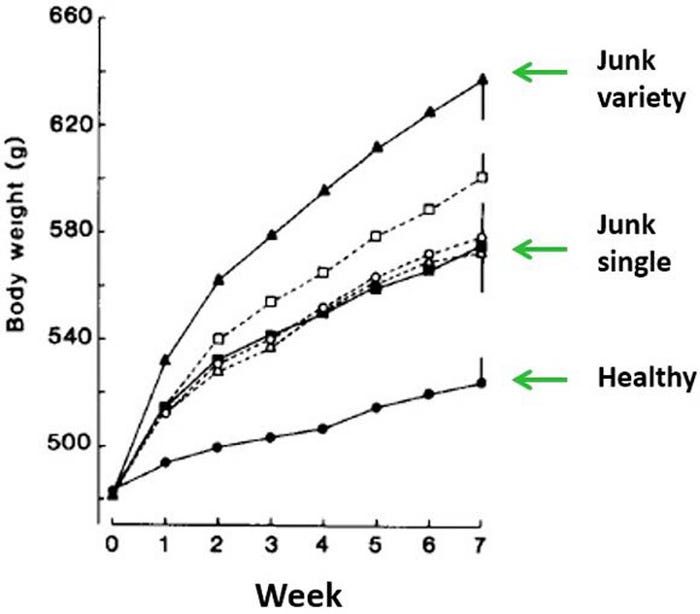
One factor that contributes to overeating is food variety.
The graph above shows a study where rats were split in 3 groups… one group got regular healthy chow, the second group got one type of junk food, but the third got multiple types of junk food at the same time (20).
As you can see, the rats eating one type of junk food gained more than the ones eating rat chow, but the rats eating multiple types of junk food gained the most… by far.
There is some evidence that this is true in humans as well. When we have more types of foods available, we eat more… and sometimes more than our bodies need (21).
8. People Don’t Burn as Many Calories When Working
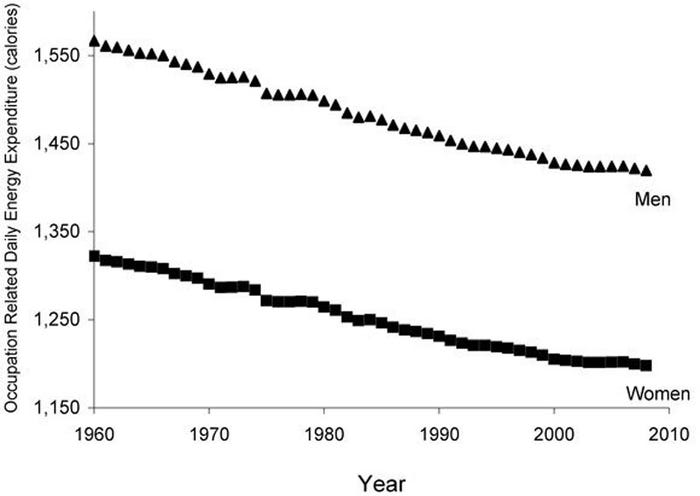
A lot of people blame obesity on decreases in physical activity, that we’re just burning fewer calories than we used to.
Although leisure time physical activity (exercise) has increased, it is also true that people now have jobs that are less physically demanding.
The graph above shows how people are now burning around 100 fewer calories per day in their jobs, which may contribute to weight gain over time.
9. People Are Eating More Vegetable Oils, Mostly From Processed Foods
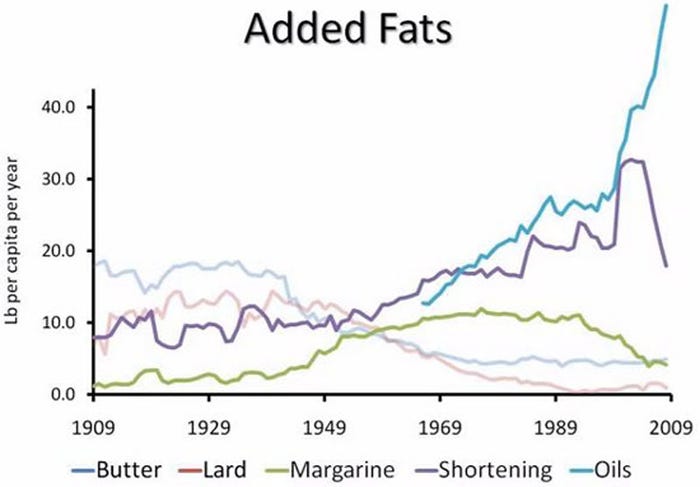
The fats we are eating have changed dramatically in the past 100 years or so.
At the beginning of the 20th century, we were eating mostly natural fats like butterand lard… but then they were replaced with margarine and vegetable oils.
Most people aren’t frying real food in vegetable oil, they are getting it from processed food. Adding these oils to the foods increases the reward and caloric value, contributing to over-consumption.
10. The Social Environment Can Strongly Affect Calorie Intake
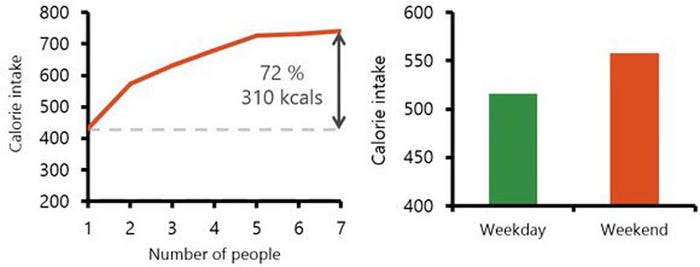
The social environment is another factor that determines calorie intake. For example, eating in a group can dramatically increase the number of calories consumed.
According to one paper, eating a meal with several people can increase calorie intake by up to 72%, or 310 calories in a single meal (22).
There are also studies showing that people tend to eat more during weekends (23).
11. People Are Sleeping Less
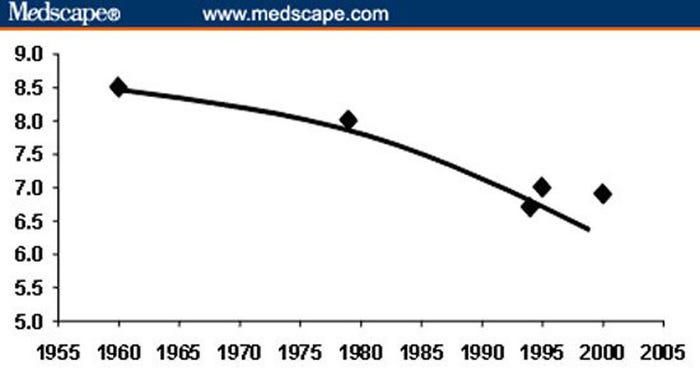
Sleep is often overlooked when it comes to weight gain and obesity.
It is known that poor sleep has negative effects on various hormones that are related to weight gain, and can contribute to increased hunger and cravings (24, 25, 26).
In recent decades, average sleep duration has decreased by 1-2 hours per night. The reasons for this are numerous, but increased artificial lighting and electronics are likely contributors.
As it turns out, short sleep duration is one of the strongest individual risk factors for obesity. It is linked to an 89% increased risk in children, and a 55% increased risk in adults (27).
12. Increased Calorie Intake
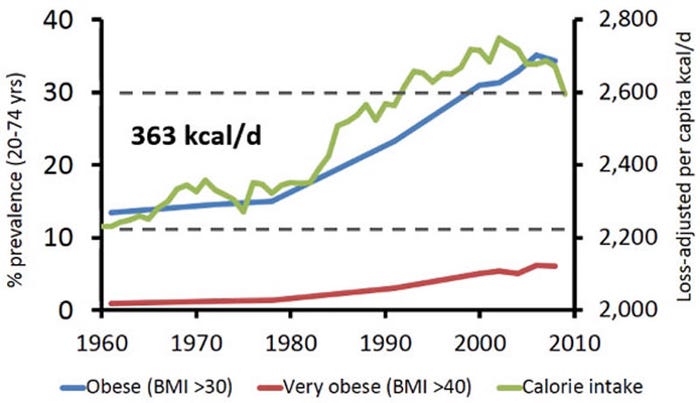
People may argue about the causes of obesity… whether it is sugar, carbs, fat, or something else.
But one indisputable fact is that calorie consumption has increased dramatically over the past few decades (28, 29).
According to studies, this increased calorie intake is more than sufficient to explain the increases in obesity (30).
But it’s important to keep in mind that it is not some collective moral failure that drives the increased calorie intake.
All behavior is driven by the underlying biology… and the way the diet and environment have changed has altered the way our brains and hormones work.
In other words, these changes have caused malfunctions in the biological systems that are supposed to prevent us from getting fat.
This is the underlying reason for the increased calorie intake and weight gain, NOT a lack of willpower, as some people would have you believe.
Consult your chiropractor

” For a healthier world “
Sources:
This article from the Authority Nutrition website. Thank you.
[7] 6 Graphs That Show Why The “War” on Fat Was a Huge Mistake
[8] Correlation does not imply causation
[9] HYPERLINK « http://jama.jamanetwork.com/article.aspx?articleid=202339 » http://jama.jamanetwork.com/article.aspx?articleid=202339
HYPERLINK « https://www.ncbi.nlm.nih.gov/pubmed/16391215 » https://www.ncbi.nlm.nih.gov/pubmed/16391215 HYPERLINK « http://jama.jamanetwork.com/article.aspx?articleid=377969 » http://jama.jamanetwork.com/article.aspx?articleid=377969https://www.ncbi.nlm.nih.gov/pubmed/16467233[10] http://ajcn.nutrition.org/content/84/2/274.full
[11] Effects of food form and timing of ingestion on appetite and energy intake in lean young adults and in young adults with obesity.
[12] Fruit juice: just another sugary drink?
[13] Relation between consumption of sugar-sweetened drinks and childhood obesity: a prospective, observational analysis
[14] Variety in the diet enhances intake in a meal and contributes to the development of obesity in the rat.
[15] Dietary variety, energy regulation, and obesity.
[16] Church TS, et al. Trends over 5 Decades in U.S. Occupation-Related Physical Activity and Their Associations with Obesity. PLoS One, 2011.
[17] Eating behavior: lessons from the real world of humans
[18] Weekly rhythms of spontaneous nutrient intake and meal pattern of humans.
[19] Dr Stephan Guyenet. HYPERLINK « http://www.youtube.com/watch?v=Mp2p4TdLn_8 » t « _blank » Why Do We Overeat? A Neurobiological Perspective. 2014. (Data from CDC NHANES surveys and USDA food disappearance data)
[20] Cauter EV, et al. The Impact of Sleep Deprivation on Hormones and Metabolism. Medscape, 2005.
[23] Increased food energy supply is more than sufficient to explain the US epidemic of obesity.


